The Thermodynamics Challenge
Transition metal perovskites ($ABO_3$) are functional powerhouses, but their synthesis typically requires solid-state calcination at $>1000^\circ C$. This brute-force method overcomes diffusion barriers of A and B site cations but results in large, sintered particles with low catalytic surface area—useless for high-performance batteries.
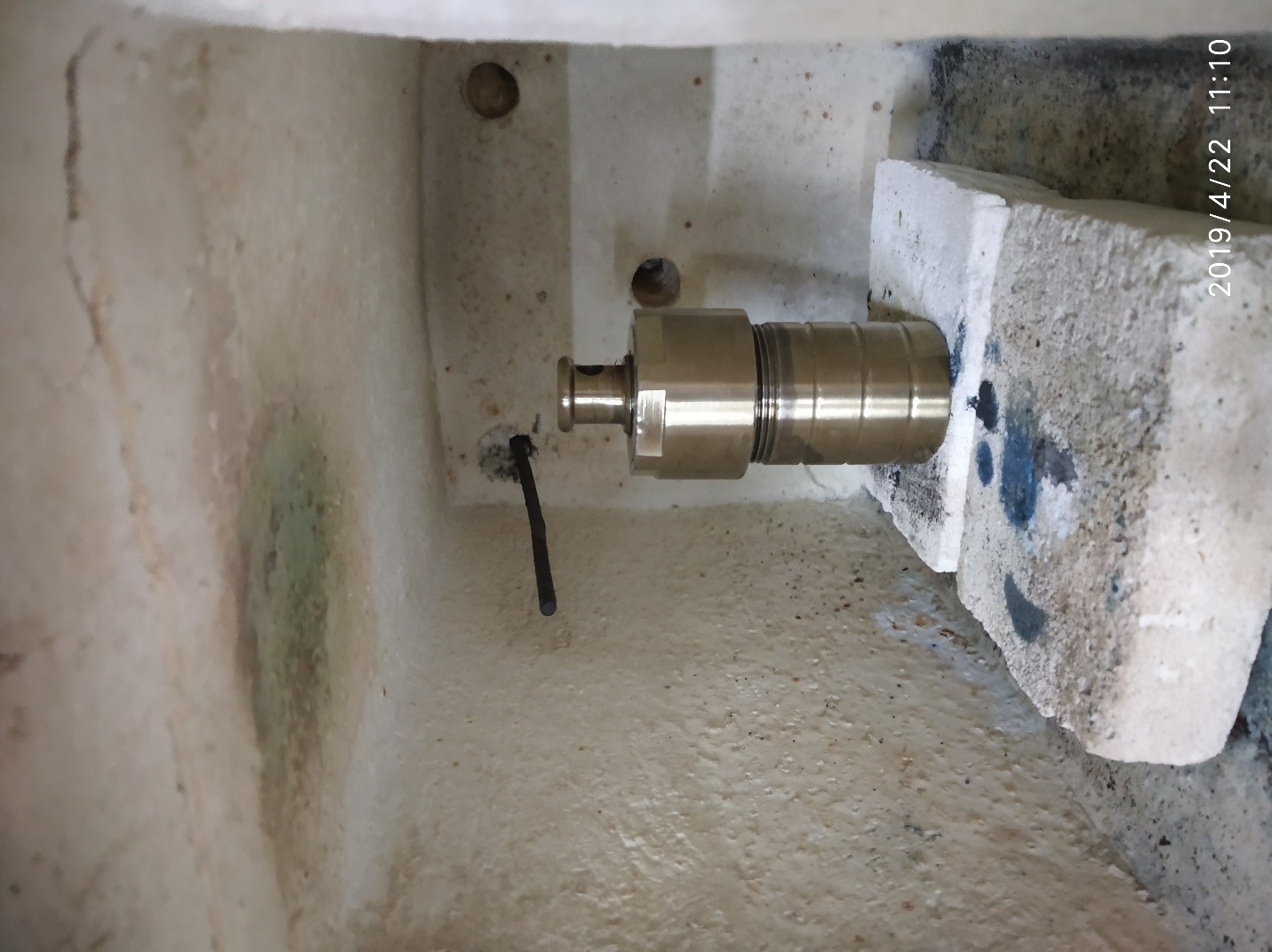
My Innovation: Tuning Morphology via “Soft Chemistry” Route The functionality of a nanomaterial is dictated by its shape and facet exposure. My doctoral research focused on “Tailoring Transition Metal Perovskites via Low-Temperature Hydrothermal Routes.” By utilizing high pressure (up to 200 bar) and alkaline mineralizers as levers to I control crystal growth kinetics. Thus, stabilized pure-phase oxides at temperatures as low as 200–240°C.
Innovation 1: “Trapping” Volatile Dopants ($La_{1-x}K_xMnO_3$)
Incorporating alkali metals (like Potassium) into the perovskite lattice is notoriously difficult due to their high vapor pressure at calcination temperatures.
- The Protocol: Developed a one-step hydrothermal route using $KOH$ as both a mineralizer and dopant source.
- Mechanism: The high alkalinity ($pH > 12$) facilitated a dissolution-recrystallization mechanism, allowing $K^+$ ions to replace $La^{3+}$ in the A-site.
- Outcome: This created $Mn^{4+}$ holes (defects) that significantly boosted the Oxygen Reduction Reaction (ORR) activity, outperforming commercial LSMO.
Key Finding
The high pressure (~15-20 bar) inside the autoclave allowed water to act as both a solvent and a reagent, facilitating the formation of uniform microcubes with defined facets.
Innovation 2: “Dynamic” Hydrothermal Synthesis (DH)
Standard static autoclaves often yield uncontrolled crystal growth due to diffusion limitations. To solve this, I developed a proprietary Dynamic Hydrothermal (DH) protocol involving in-situ stirring at high temperatures ($265^\circ C$).
Case Study: $WO_3$ Nanorods For aqueous Zn-ion batteries, we required an anode with high surface area and structural stability.
- Method: Teflon-lined stainless steel autoclaves at 180°C.
- Control: By adjusting the precursor pH and shear force (stirring), I directed crystal growth along the [001] axis.
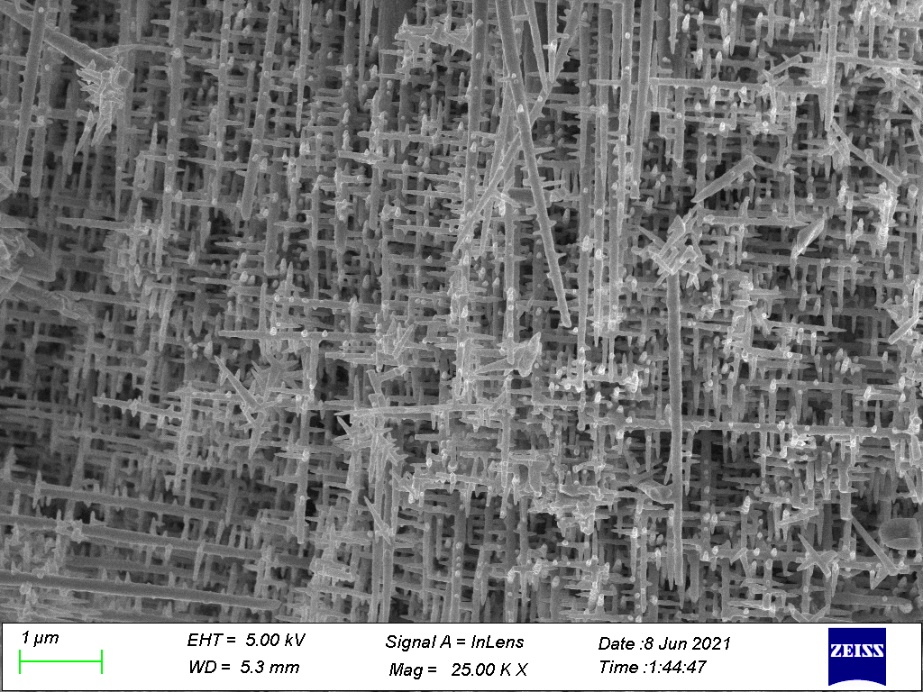
- Result: Uniform Nanorods with high aspect ratios, providing direct electron transport pathways for aqueous Zn-ion batteries (stable for >1000 cycles). Also, excellent cycle stability (over 1000 cycles) due to effective strain relaxation during $Zn^{2+}$ insertion.
Visual Methodology
📜 Source & Citation
Note: The methodology described above is adapted from the author's doctoral research. To use this data in your work, please cite the original thesis:
Kotha, V. (2022). Tailoring Transition Metal Perovskite Oxides via Low-Temperature Hydrothermal Routes as Potential Candidates for Catalytic Applications [Doctoral dissertation, IIT Bombay].