The Surface is the Stage
In electrocatalysis, the bulk formula doesn’t matter as much as the surface state. To understand why my K-substituted Perovskites outperformed standard catalysts, I had to probe the top few nanometers of the material.
1. X-Ray Photoelectron Spectroscopy (XPS)
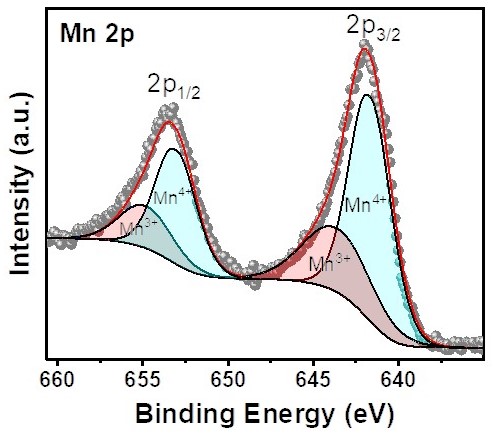
- The Query: Did Potassium substitution actually change the manganese oxidation state?
- The Analysis: I performed high-resolution deconvolution of the Mn 2p spectra.
- The Finding: The spectra revealed a shift in the $Mn^{3+}/Mn^{4+}$ ratio. The incorporation of $K^+$ created significant $Mn^{4+}$ surface defects, which act as the primary active sites for oxygen adsorption during the ORR process.
2. Electrochemical Impedance Spectroscopy (EIS)
- The Query: Is the catalyst inherently faster, or just more conductive?
- The Analysis: I modeled the Nyquist plots using a Randles equivalent circuit.
- The Finding: The K-substituted samples showed a drastically reduced Charge Transfer Resistance ($R_{ct}$) compared to the pristine sample, confirming faster electron transfer kinetics at the electrode-electrolyte interface.
Visual Methodology

📜 Source & Citation
Note: Data derived from the author's doctoral research. Citation:
Kotha, V. (2022). Tailoring Transition Metal Perovskite Oxides via Low-Temperature Hydrothermal Routes as Potential Candidates for Catalytic Applications [Doctoral dissertation, IIT Bombay].